

As we navigate the complexities of cyber underwriting in 2026, the industry has reached a breaking point: traditional applications and external scans are no longer enough to predict loss. In a landscape where vulnerabilities surface every 17 minutes and threat actors strike 11 times a minute, what looks like a “gold-standard” risk on paper today could be a catastrophic claim by tomorrow.
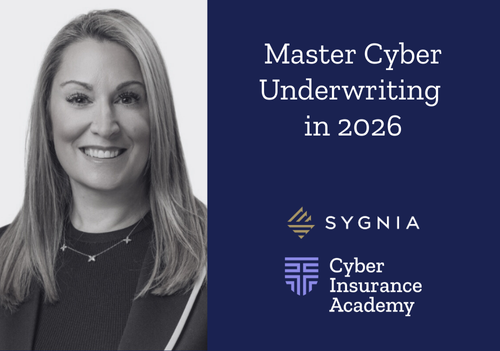
But the challenge isn’t a lack of data, it’s a lack of collaborative visibility across the cyber policy value chain. This was the overarching observation delivered by Elissa Doroff, Director of Cyber Insurance at Sygnia, in our recent Masterclass, Lessons from Loss: “The cyber insurance application is simply a snapshot in time. Everybody knows that cyber risk is fluid.” To bridge this gap, forward-thinking insurers are moving beyond “drive-by” external scans and embracing continuous intelligence – an integrated feedback loop between claims, underwriting, and real-world Incident Response (IR) data.
Here is how to evolve your underwriting framework from a static document into a dynamic, data-driven engine.
What are the Limitations of Traditional Underwriting?
Despite advances in submission processes and technical calls, cyber underwriting in 2026 remains fundamentally static. Smaller businesses often provide only basic information such as revenue, industry, and high-level data classifications. Larger organizations undergo technical calls where underwriters probe controls, compliance, identity management, and network segmentation. Yet even in these scenarios, the information is inherently a point-in-time reflection.
Why External Scans Aren’t Enough
Many insurers rely on external scanning tools to bridge the visibility gap. However, as Elissa points out, “These scans are helpful, but they’re not getting behind the firewalls.”
Think of it as a “drive-by” inspection of a house:
- The Outside: The doors are locked, the roof looks intact, and the paint is fresh.
- The Inside: Behind the front door, the electrical wiring is failing and the structure is compromised.
External scans cannot reveal internal control failures. For true risk assessment, underwriters must question the alignment between scan data and actual internal application responses.
How to Overcome the “Trust Gap” in Continuous Underwriting
A major hurdle for data-driven cyber underwriting is the perceived “Trust Gap.” While insurers offer proactive services – tabletop exercises, privacy awareness training, anomaly detection, and threat alerts – many insureds view these as punitive.
“Companies worry: if my insurer is monitoring my network… is that going to negatively impact my premiums?” – Elissa Doroff
This hesitation leads to low uptake of these services, despite them often being complementary and demonstrably effective. To overcome this challenge to cyber underwriting in 2026, insurers must demonstrate that continuous monitoring isn’t about punishment; it’s about capturing emerging risk indicators; it’s about emerging risk indicators such as misconfigurations, shadow IT, or new vendor connections that traditional questionnaires miss entirely.
What is Shadow IT?
Shadow IT is the use of software, cloud services, or devices for work without approval or visibility from IT or security teams. It affects cyber insurance underwriting because these unmanaged systems often lack controls like MFA, logging, and patching, creating hidden entry points that increase the likelihood, cost, and complexity of cyber claims.
The Power of Cyber Claims and Underwriting Collaboration
The disconnect between stated controls and actual controls only becomes visible during a claim. It is the “moment of truth” for MFA implementation, network segmentation, logging, and backups and monitoring.
By integrating forensic findings from claims back into the underwriting process, insurers can:
- Reduce Ambiguity: Refine coverage language to align policy intent with real-world attack vectors.
- Validate Controls: Compare application submissions against actual forensic reality.
- Improve Certainty: Create a feedback loop that ensures the claims and underwriting teams are speaking the same language.
Leveraging Incident Response (IR) Data for Continuous Intelligence
Cyber underwriting in 2026 should increase its dependence on incident response (IR) data for accurate, real-time assessment.
“Assessments and scans can help predict risk, but incidents reveal the reality of what happens,” notes Elissa.
IR data provides a granular view of how different industries experience loss:
- Healthcare: Focuses on life-critical downtime.
- Retail: Focuses on revenue-impacting outages.
- Manufacturing: Focuses on production halts.
By integrating IR insights into cyber underwriting, insurers can refine pricing, optimize coverage, and enhance resilience planning.
Key IR Performance Metrics for Cyber Underwriting in 2026
To move toward continuous intelligence, underwriters should analyze forensic benchmarks that prove how a company performs under fire. In 2026, the gold standard for cyber underwriting should be defined IR metrics including:
- MTTD (Mean Time to Detect): How long the “burglar” is in the house before the alarm sounds.
- MTTC (Mean Time to Contain): How fast the insured can “lock the internal doors” to stop lateral movement.
- MTTR (Mean Time to Recover): The speed at which business operations return to 100%.
These metrics reveal fundamental weaknesses and actionable benchmarks for assessing risk, allowing underwriters to price risk based on an organization’s actual resilience.
How IR Data Refines Coverage
IR data reveals exactly where the money goes during a crisis. Industry trends show that 47% of total incident costs are now driven by crisis services, while 88% of small incidents are ransomware-related. Insurers can use these insights to design more granular sub-limits for Business Interruption (BI), for example, and to guide policyholders toward more effective risk management before the demand arrives.
How IR Data Calibrates Pricing
While ransomware makes headlines, Business Email Compromise (BEC) and human error drive the highest frequency of claims in 2026. The increasing sophistication of social engineering attacks, coupled with limited IT resources, SOC capabilities, and internal logging, make SMBs particularly vulnerable. Even when incidents are unreported or absorbed within retention, continuous, predictive IR data allows “near misses.” This allows insurers to price premiums based on Actual Control Performance rather than “Assumed Security.”
Scenario: How IR Metrics Could Predict IT/OT Segmentation Failure and Inform Underwriting
Two manufacturing plants apply for coverage. Both have “Gold Standard” perimeter security. However, their internal architectures tell different stories:
- Plant A: Has a Flat Network (the office computers (IT) and the assembly line controllers (OT) sit on the same digital floor with little-to-no segmentation). This means that, if a single laptop is phished, the “blast radius” would include the entire factory floor. A tabletop exercise/simulation would reveal a High Predicted MTTC, that would be priced into Plant A’s cyber liability policy.
- Plant B: Employs Protocol-Level Segmentation (the IT and OT environments are separated by a firewall that allows data to flow in only one direction). This would minimize lateral movement between the IT and OT networks, enabling an attack like that on Plant A to be contained before it ever touches the machines. The predicted MTTC would be low and would impact underwriting decisions accordingly.
Cyber Underwriting Conclusion: Even with zero prior claims, Plant B receives a significantly lower premium and higher business interruption limits. The predicted IR data shows that an IT breach won’t snowball into an OT catastrophe.
Conclusion: The Future of Cyber Underwriting in 2026
The solution to static, point-in-time underwriting is continuous intelligence. This is an integrated, ongoing feedback loop connecting underwriting, claims, and IR. By turning incident insights into actionable intelligence, insurers in 2026 will not only price risk more accurately but will also act as true partners in their clients’ resilience.
Watch the full recording of Elissa’s Masterclass: Lessons from Loss.